
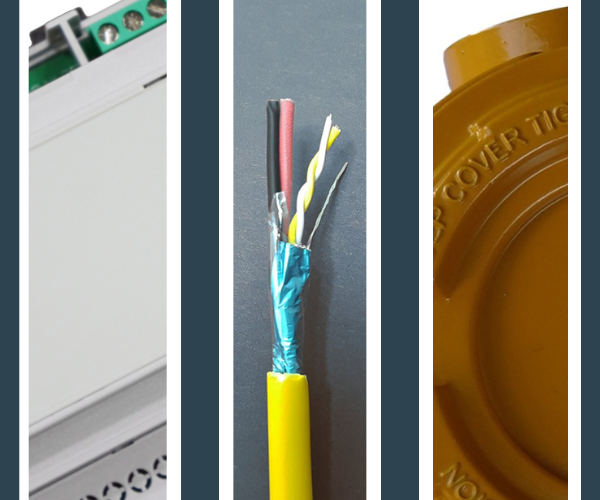
Industrial automation reliability is rarely determined by a single component. It is shaped by how current loading, heat dissipation, and environmental limits interact across a control system. Control panel cable defines conductor losses and heat generation, remote relay modules translate those conditions into switching behavior, and atex junction boxes impose strict limits on temperature rise and enclosure integrity. When these components are considered independently, small electrical and thermal mismatches can compound over time. The outcome is signal instability, accelerated component aging, or increased compliance risk, particularly in hazardous areas where design margins are limited. A coordinated selection approach aligns conductor sizing, current and contact characteristics, and enclosure thermal limits during control system design, ensuring that heat generation, switching performance, and atex temperature classes remain compatible under real operating conditions.
Control panel cable selection
Conductor specification
Choosing the right control panel cable requires matching conductor sizing to the thermal reality of the enclosure, not just the nominal current it carries. IEC 60204-1 defines minimum requirements, but control panels typically operate with restricted airflow, high wiring density, and sustained loading. In these cases, I²R losses remain concentrated within the wiring system, driving temperature increasing and accelerating insulation aging.
Installation conditions also impact conductor specification by directly influencing heat dissipation. Continuous current, conductor bundling, and duct fill all raise conductor temperature in compact panels. In densely wired control panels, specifying a larger cross-sectional area improves reliability primarily by reducing resistive heat generation rather than extending nominal current capacity.
Insulation and jacket chemistry
Insulation choice is an integral part of control panel cable selection because it affects both signal behavior and service life. Control panel cables carrying fast-switching or mixed-signal circuits benefit from insulation with a low dielectric constant, which limits capacitive coupling and reduces signal attenuation in compact, densely wired panels.
Additionally, jacket temperature rating should be chosen according to enclosure conditions instead of ambient air temperature. Heat generated by conductors, adjacent wiring, and internal components often raises internal temperatures well above room conditions. In practice:
- 70 °C jackets suit ventilated, low-density panels
- 90 °C jackets suit compact panels with mixed wiring
- 105 °C jackets suit continuous-duty or high-density installations.
A suitable jacket rating slows insulation aging and supports stable electrical properties over the control panel cable's service life.
Remote relay module selection
Contact materials science
Remote relay module selection should align with the electrical conditions delivered by the control panel cable. Inductive loads generate high inrush currents that accelerate contact erosion during switching. Relay modules using silver tin oxide contacts tolerate these stresses more effectively, reducing the likelihood of contact welding under repeated load cycling.
Low-level control circuits present different failure mechanisms. At voltages below 10 V, contact oxidation becomes the dominant contributor to instability. Within low-voltage control circuits, remote relay modules with gold-plated contacts provide lower and more consistent contact resistance, ensuring that signal integrity maintained by the control panel cable is not degraded at the switching interface.
Switching dynamics
Remote relay module technology choice is governed by duty cycle, load characteristics, and isolation requirements. Solid-state remote relay modules suit high-cycle applications where mechanical wear would otherwise limit service life. In contrast, electromechanical remote relay modules are preferred where physical isolation, clear off-states, and predictable end-of-life behavior are required. Control panel cable characteristics directly influence remote relay module selection. Impedance, leakage current, and thermal contribution can affect relay behavior, especially in low-level or high-density installations. Considering the control panel cable alongside the remote relay module prevents mismatches that only become apparent during operation, such as contact instability caused by leakage current or unreliable switching at low signal levels.
Atex junction box selection
Environmental material science
Atex junction box selection should reflect environmental exposure, as enclosure material directly affects durability and compliance. Stainless steel 316L suits saline or chemically aggressive locations, while glass reinforced polyester provides corrosion resistance with lower weight where mounting loads are constrained. For non-metallic atex junction boxes, antistatic performance is critical for preventing electrostatic charge accumulation that could lead to an ignition-capable discharge. Surface resistivity must remain within specified limits, and control panel cable entry systems must sustain this behavior through compatible materials and grounding, including antistatic cable glands and conductive bonding paths.
Temperature class, ingress protection, and sealing
Temperature class requirements determine which atex junction boxes are suitable for a given installation by limiting the allowable external temperature. Heat generated by relay modules and conducted through control panel cable must remain low enough that enclosure surfaces stay below ignition thresholds for the surrounding atmosphere. That way, the atex junction box remains compliant with its assigned temperature class throughout normal operation.
Ingress protection capability further constrains atex junction box choice and depends largely on how the enclosure is sealed at joints and cable entry points. Gasket design plays a central role in maintaining the ingress protection seal that prevents dust and moisture from entering the atex junction box. Silicone gaskets accommodate wider temperature ranges, while Ethylene Propylene Diene Monomer (EPDM) is appropriate for standard industrial conditions. Long-term compliance depends on the enclosure and its cable entry hardware maintaining consistent gasket compression so the sealing interface remains effective throughout the enclosure's operational life.
Aligning components for long-term reliability
Ensuring the control panel cable, remote relay module, and atex junction box are well-matched ensures electrical loading, thermal behavior, and hazardous-area constraints remain aligned throughout operation. Duran Electronica can offer Durgas cable for control panel wiring, remote relay module solutions for control and communication circuits, like 4-20 mA and RS485, and atex junction boxes for Zone 1 and Zone 2 installations. Utilizing these components together can simplify validation, reduce fault risk, and support stable performance throughout the lifetime of the installation. Contact our team to discuss your application and confirm the most appropriate configuration.