
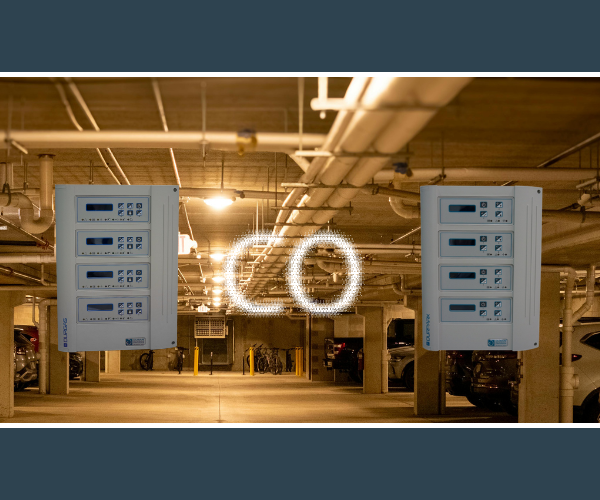
Carbon monoxide (CO) is invisible, odorless, and unforgiving. In enclosed parking garages, it accumulates quietly, especially during peak traffic periods or cold starts. Many older garages rely on ventilation strategies, such as continuous fan operation, fixed schedules, or manual control, to manage air quality. These systems were never designed to adjust dynamically as traffic patterns change or emissions build up. They were developed before continuous gas monitoring was practical, leaving fan operation disconnected from the current risk inside the space.
Upgrading legacy garages with a smart carbon monoxide control panel aligns ventilation operation with current carbon monoxide levels. By centralizing gas detection and fan control, carbon monoxide control panels transform passive ventilation infrastructure into an active safety system. The result is not only better protection for occupants, but a practical pathway to meeting modern ventilation and safety requirements without replacing the garage itself.
Why Static Ventilation Systems Fail in Legacy Garages
The weaknesses of static ventilation systems are most evident in everyday operation. Many legacy garages handle ventilation through continuous fan operation or fixed schedules. Fans are switched on because it is time to ventilate, not because exhaust levels have increased. Such a mode of operation reflects how these systems were originally designed to prioritize a constant safety margin rather than adapt to variations in vehicle activity and carbon monoxide concentration. While airflow is always present, ventilation remains disconnected from what is actually happening inside the garage.
Over time, that disconnect generates operational problems. Fans run at full output during low-traffic periods, consuming energy without improving air quality. At the same time, motors and mechanical components are exposed to constant load, accelerating wear and increasing maintenance demands. The system appears simple and robust, but its lack of adaptability turns safety into excess and reliability into avoidable cost.
Gas detection follows a similar pattern. Where carbon monoxide sensors are installed, they often operate as isolated devices, lacking centralized supervision. The sensing elements within carbon monoxide sensors degrade over time, leading to calibration drift that reduces accuracy without triggering any system-level indication. Ventilation will continue to respond, but increasingly on the basis of uncertain data. Current building and safety regulations emphasize demand-controlled ventilation, documented alarm behavior, and verified system performance, which static systems struggle to deliver. In the absence of a smart carbon monoxide control panel to unify detection, management, and reporting, legacy garages remain poorly equipped to respond to changing air quality conditions, sensor degradation, and regulatory scrutiny.
How a Smart Carbon Monoxide Control Panel Works in a Legacy Garage Retrofit
Ventilation retrofits in legacy garages link carbon monoxide detection and fan operation through a single control platform. A smart carbon monoxide control panel replaces fragmented control logic, where sensors, relays, and fans operate independently, with a centralized platform that continuously receives data from sensors distributed throughout the legacy garage. Instead of reacting to simple on-off signals, the carbon monoxide control panel evaluates measured carbon monoxide concentrations across zones and levels, allowing ventilation decisions to be based on actual conditions inside the space.
From that point, the smart carbon monoxide control panel adjusts fan speed according to measured carbon monoxide concentrations. Communication with Variable Frequency Drives (VFD) allows fan output to be modulated as gas levels rise and fall. During low-emission periods, fans operate at reduced speed, then increase output smoothly as exhaust accumulates. In legacy garages, this delivers effective ventilation while avoiding the energy penalty of constant full-speed operation.
A Practical Roadmap for Upgrading Legacy Garage Ventilation with a Smart Carbon Monoxide Control Panel
Successfully upgrading the ventilation system of a legacy garage requires knowledge of how air actually moves through the space. Older garages often have irregular layouts, low ceilings, and airflow dead zones created by ramps, beams, and structural columns. A detailed site audit can identify where exhaust gases tend to accumulate, ensuring carbon monoxide sensors are positioned based on exposure risk rather than installation convenience.
Once the carbon monoxide sensor has been established through a site audit, the focus should shift to upgrading the ventilation control layer by installing the smart carbon monoxide control panel. Within most legacy garages, this involves replacing an outdated relay cabinet that provides only basic fan switching. The new carbon monoxide control panel consolidates gas detection, ventilation control, and alarms into a single system, ensuring operations have clear visibility into live gas readings, fan status, and alarm conditions across the garage.
Calibration and system configuration then determine how the upgraded ventilation system responds to changing conditions. A smart carbon monoxide control panel supports multiple response thresholds, allowing low-speed ventilation to maintain baseline air quality while higher concentrations trigger increased airflow and alarms. These settings can be aligned with regulatory limits and current traffic patterns, rather than relying on fixed, conservative defaults.
An upgraded ventilation control system can adapt as garage use changes. Legacy garages increasingly accommodate delivery vehicles and diesel-powered fleets, introducing exhaust risks beyond carbon monoxide alone. A smart carbon monoxide control panel accommodates this evolution by allowing additional gas detection, for instance nitrogen dioxide sensors, to be incorporated without altering the underlying ventilation or control system. Safety performance can therefore be improved incrementally rather than through repeated system replacement.
Reliable Smart Carbon Monoxide Control Panels for Legacy Garage Retrofits
Complex garage retrofits place high demands on ventilation control and gas monitoring systems. They must be reliable under continuous operation, scalable across multiple parking levels, and serviceable over long lifecycles. Systems such as DURPARK and DURGAS , developed by Duran Electrónica, are engineered specifically for the operational and physical constraints of legacy garages, supporting up to four communication loops and sixty-four detectors within a single smart carbon monoxide control panel configuration. This capacity allows large or segmented legacy garages to operate under one coordinated control system rather than as a collection of isolated panels. For additional information about the products from Duran Electronica for legacy garages, speak with our specialists.